House Edge Explained: What It Means in Crypto Casino Gambling

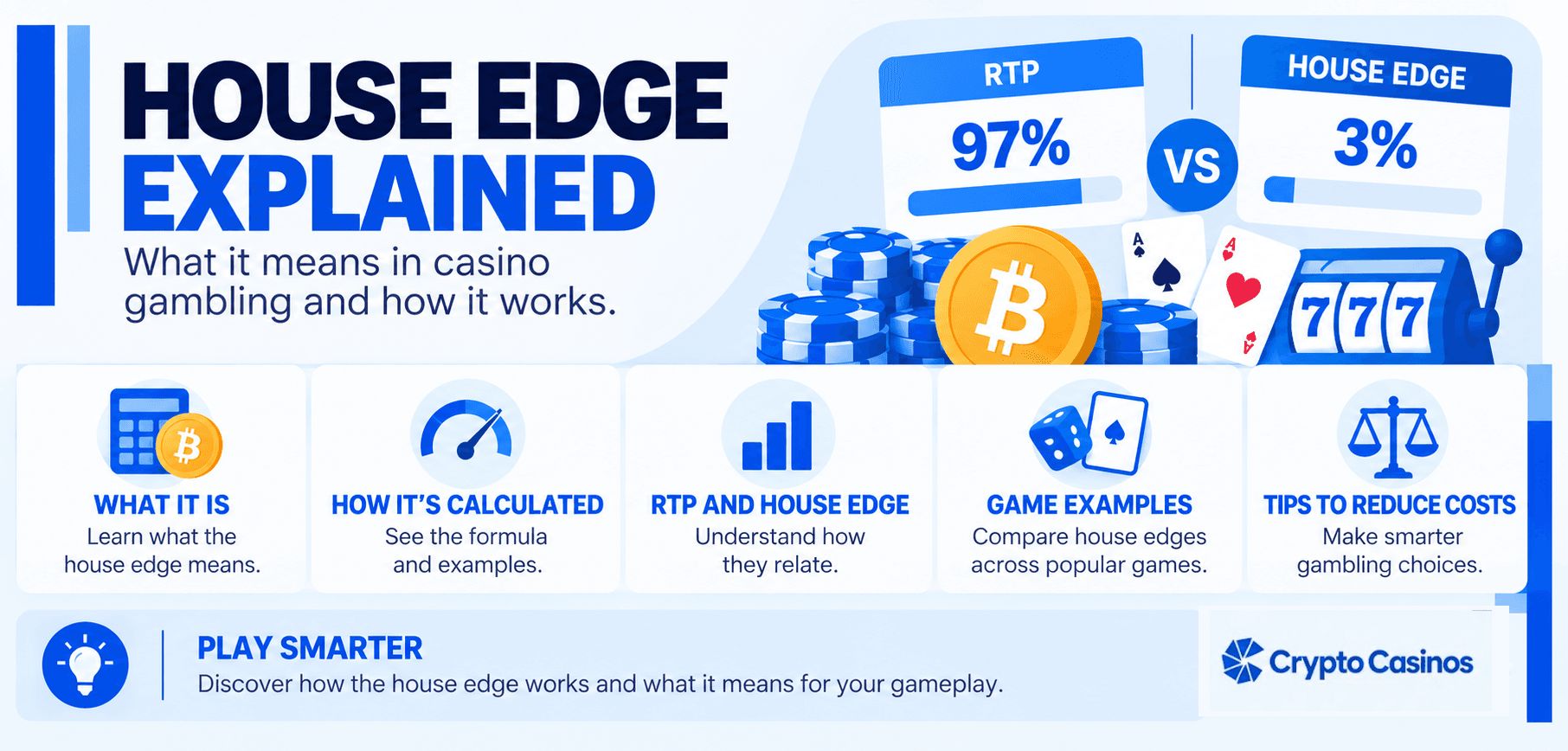
House edge estimates the casino’s profit from your bets, but does that mean you will always lose? Not really. In this guide, we’ll explain what house edge is, how it relates to RTP, and how to calculate potential losses while reducing gambling costs.
What Is the House Edge in Gambling?
What is the house edge in gambling? Simply put, it represents the mathematical advantage a casino game has over players. It’s expressed as a percentage of the amount wagered, like 3%. This number is the expected share of all wagers a crypto casino will keep over the long run, not how much it earns from each bet.
Simply put, if a game has a 3% house edge and you wager $100 over a longer period, your expected loss is $3 when you combine all wins and losses. The house edge is built into the math of all casino gambling games, taking into account probabilities, mechanics and prize structure.

“One common misconception I see among players is that the house edge predicts the outcome of a single session or round. A 5% house edge doesn’t mean you’ll lose $5 if you play $100 in a single session. It’s just a general statistic that estimates a $5 loss per $100 wager across many bets.”
How Is Casino House Edge Calculated?
In most cases, online casinos will not display the house edge but will give you the theoretical return to player. Luckily, you can use RTP to calculate the house edge easily. Here’s the formula:
100% - RTP (%) = House Edge
For example, if a casino slot has an RTP of 97%, here’s how you calculate its house edge:
100% - 97% (RTP) = 3% (House Edge)
What Is RTP in a Casino?
Return to player (RTP) in casino gambling refers to the percentage of all wagers a game is theoretically expected to return to players over the long run. In other words, a casino game with 97% RTP will theoretically return $97 of every $100 you wager across a long gaming sample. RTP is built into every game, including provably fair Bitcoin games.
In other words, house edge and RTP are the opposite parts of one mathematical equation for standard casino games. If games are designed and function properly, both the house edge and RTP should approach the theoretical figure after a large volume of play.
The Relationship Between House Edge & RTP
So, what is house edge and RTP, and how do they relate? House edge and RTP together contribute to 100% of the amount wagered. Their relationship determines how much the player gets back and how much the casino earns over the long term.
House Edge + RTP = 100%
This relationship applies to standard casino games. Other games like peer-to-peer poker have additional considerations such as rake. Their combined total is 100%, so if one goes up, the other goes down. For example, if the RTP is 98%, the house edge can only be 2%, no more, no less.
| House Edge | Return to Player |
| Represents the casino’s theoretical advantage | Represents the players’ theoretical return |
| The lower it is, the better it generally is for players | Higher percentages favor players more |
| Measures expected losses over the long term | Measures expected payouts over the long term |
| Usually available for baccarat, roulette and blackjack | Commonly displayed for slots, crash and arcades |
How House Edge Affects Expected Losses
Here’s how you can use the house edge to create an estimated cost of playing over a longer period:
Amount Wagered x House Edge ÷ 100 = Estimated Loss
Here’s an example table with different house edge percentages and expected losses over long-term gameplay.
| Total Amount Wagered | House Edge | Calculation | Expected Loss |
| $100 | 1% | $100 × 1 ÷ 100 | $1 |
| $300 | 3% | $300 × 3 ÷ 100 | $9 |
| $500 | 5% | $500 × 5 ÷ 100 | $25 |
Keep in mind that these numbers represent mathematical expectations, not guaranteed losses. At the same time, these are small amounts that showcase theoretical calculations, but you would have to play longer to get close to the actual house edge.

“I always remind players that the house edge in gambling is a built-in feature that applies to everyone who plays. It doesn’t mean you can’t win or lose more than expected during a session. You might win big at that point while others lose, but the house edge gives the casino a mathematical edge over time.”
Does a Lower House Edge Mean Better Chances of Winning?
Not by default. A lower house edge means the casino takes less from your bets on average relative to how much you wagered. However, it doesn’t tell you when or how often you’ll win. For example, two crash games can have 97% RTP but behave differently.
One might offer more frequent but smaller payouts, while the other might offer fewer wins with bigger payouts. This difference comes from the game's volatility, which reflects how drastic the outcome swings are. In other words, a high-RTP slot can still be highly volatile, giving substantial losses before rewarding players with a large win.
“When I’m comparing slots, I also check the hit frequency and maximum payout apart from the RTP. These three factors tell me more about what to expect from the gameplay itself. A high RTP and low house edge can look attractive, but that doesn’t mean the game is perfect if you like small bets and want higher chances of a payout before spending your budget.”
House Edge and RTP Comparison by Casino Game
House edge varies by casino game. Some games have a fixed house edge and RTP, while others, like crypto slots, are more flexible. Here’s a quick comparison table to show you what to expect.
| Casino Game | House Edge | Return to Player |
| Slots | Varied (2%–6%) | Typically 94%–98% |
| Baccarat | 1.06% banker bet, 1.24% player bet | 98.59% banker bet, 98.76% player bet |
| Roulette | 2.70% European, 5.26% American | 97.30% European, 94.74% American |
| Blackjack | Around 0.5% | Around 99.5% |
| Crash Games | 1%–5% | 95%–99% |
House edge and RTP numbers are theoretical and general representations. The ranges are illustrative and not guaranteed. House edge can vary by game, provider or configuration and table game returns also depend on strategy.
How to Find the RTP and House Edge of a Casino Game
In all of our crypto casino reviews, we were always able to find the game's RTP and house edge. All modern casinos display this information transparently, including the best provably fair crypto casinos, which also let players verify game outcomes. Don’t assume these numbers. Make sure to check them. Here’s how.
Go to the casino’s game lobby, find the game you’re interested in and launch it. Even if you haven’t registered yet, most casinos let you open games in demo mode.
Once the game has launched, look for the information icon, like a gear or document, located in one of the window’s corners. Tap or click it.
Look for the section about RTP or payout information. While you’re there, don’t miss the opportunity to learn about its game rules, paytable and mechanics.
How to Reduce the Expected Costs of Crypto Gambling
Beyond finding the best payout casinos, you can make decisions that may help reduce expected losses.
House Edge: FAQs
What is a good casino house edge?
What does 3% house edge mean?
Can a casino change a game’s house edge?
Can I beat the casino’s house edge?

Vladimir is a senior iGaming writer and editor, adept at breaking down the key details of crypto casinos and sportsbooks so players don’t have to, delivering honest, player-focused information that actually matters.