
Crypto Network Fees: Casino Beginner’s Guide 2026

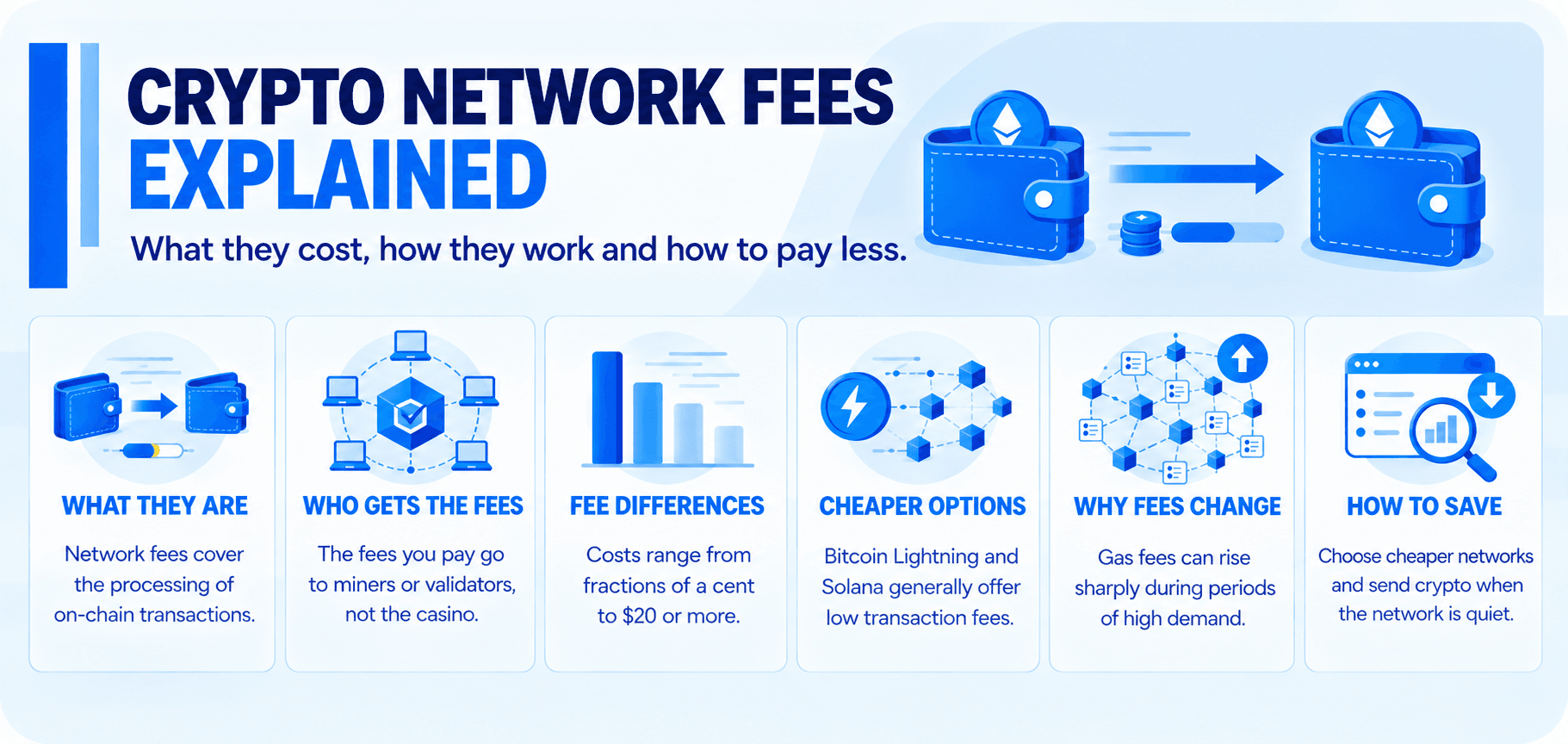
Most blockchain transactions you make come with crypto network fees, and it’s important to understand how they work before gambling online. We’ll cover what crypto gas fees are, why and when you have to pay them, how to lower or avoid them and which networks are the most cost-effective for casino transactions.
What Are Gas Fees in Crypto Gambling?
Crypto network fees, often called gas fees, are the costs attached to every transaction you want to make on a blockchain. They compensate validators or miners for processing and validating transactions, and also help prevent spam attacks.
You usually pay crypto gas fees in the blockchain’s native token. For example, sending USDT on Ethereum (ERC-20) requires you to have ETH in your crypto wallet to cover gas fees.
Each blockchain has a limited capacity for processing transactions, determined by factors such as its block capacity. When too many people try to send crypto at the same time and demand exceeds the available capacity, the network gets congested. In such cases, you may have to pay higher fees to have your transactions processed.
The crypto gas fees you’re subject to differ between blockchains because each has its own way of processing transactions and calculating fees. Some prioritize decentralization and security, while others are designed to handle more transactions per second. Also, on some blockchains, such as Bitcoin, you may pay a higher transaction fee to increase the chances of your transaction being processed sooner.

"The terms 'gas fees' and 'crypto network fees' are often used interchangeably online, just like we do on this page. But strictly speaking, 'gas fees' are a type of network fee used by blockchains such as Ethereum."
Crypto Network Fees vs Casino Fees: Differences
Crypto network fees and casino fees are two different types of costs that are often confused with each other:
- Crypto gas fees are paid to blockchain validators or miners, not casinos. Every on-chain transaction incurs a network fee, which is usually covered by you. In some cases, casino operators may cover these for you, especially if you’re a VIP player.
- Casino fees are charges imposed by casino operators for processing your deposits or withdrawals. Many crypto casino sites don’t add their own transaction fees, so you only pay the blockchain network fee when depositing or withdrawing funds.
Casino cashiers usually display applicable fees before you confirm a transaction, helping you understand the costs before depositing or withdrawing.
Network Fees and Confirmation Times by Chain
The table below compares approximate crypto network fees, typical block or slot times and fee models for Bitcoin, Bitcoin Lightning, Ethereum, Solana and TRON.
| Chain | Type | Approx. Fee | Block/Payment Time | Fee Model |
| Bitcoin | Layer 1 | $1-$5 | ~10 min per block | Transaction size and network demand |
| Bitcoin Lightning | Layer 2 | <$0.01 | Near-instant | Routing fees charged by payment channels |
| Ethereum | Layer 1 | $1-$20 | ~12 sec per block | Gas used, base fee and optional priority fee |
| Solana | Layer 1 | ~$0.001 | ~400ms per slot | Base transaction fee plus an optional priority fee |
| TRON | Layer 1 | $1-$3 | ~3 sec per block | Bandwidth and Energy resource model |
Important: The figures above are averages under normal conditions and may change under congestion.
Ethereum Gas Fees
Ethereum uses the EIP-1559 fee model, with a base fee that’s burned and an optional priority fee paid to validators. The base fee can rise by up to 12.5% per block when demand is high.
The total fee you pay for a transaction on Ethereum depends on the gas used and the effective gas price: gas fee = gas used × effective gas price. A standard ETH transfer uses 21,000 gas, while an ERC-20 token approval typically requires around 45,000 gas. During heavy congestion, fees can reach tens of dollars. The average Ethereum transaction fee reached $53.16 on May 10, 2021, although costs have been lower in recent years. As reported by CoinLedger, average Ethereum gas prices fell from over 220 gwei during 2020–2021 spikes to 1–3 gwei in 2025.
Ethereum produces a new block roughly every 12 seconds, so your transaction may be included in the next block within that time. However, inclusion doesn't mean full confirmation, and network congestion can delay processing.
You can pay less in fees and enjoy faster transactions by using Ethereum Layer 2 networks, such as Arbitrum and Optimism, which process transactions separately from the main chain. EIP-4844 introduced data blobs, which let Layer 2 networks post transaction data to Ethereum at a lower cost, helping reduce their fees. Ethereum casinos that support L2 networks include BC.Game and Lucky Block.

“I once deposited $50 in USDT using the ERC-20 network at Betplay and selected the slow-speed option, which reduced the gas fee to $0.23. That fee amounted to about 0.46% of my deposit. The transaction was confirmed in about a minute, and the funds appeared in my account another minute later.”
Solana Transaction Fees
Solana is one of the cheapest crypto to send, since it has a base transaction fee of 5,000 lamports (0.000005 SOL) per signature. This amounts to a fraction of a cent at typical SOL prices. And if you want to increase the likelihood of your transaction being processed ahead of competing ones, you may pay optional priority fees.
Unlike Ethereum, Solana's base crypto network fee doesn't fluctuate with network demand. However, priority fees can increase during periods of congestion, so the total cost may vary depending on network activity and the transaction you're making.
Solana produces a new slot roughly every 400 milliseconds, allowing transactions to be processed quickly. However, this doesn't mean every transaction is fully confirmed within that time. Deposit and withdrawal speed also depends on each Solana casino's internal processing procedures and policies.
TRON Transaction Fees
TRON uses an Energy and Bandwidth system instead of a traditional crypto gas fee model. Bandwidth covers the data used by a transaction, while Energy pays for the computation needed to execute smart contracts. You can get these resources by staking TRX or having someone lend them to you. If you don't have enough, the network automatically burns TRX from your balance to compensate for the resources used.
For example, USDT transfers on TRC-20 can cost you more than a simple TRX transfer because they require Energy to execute a smart contract. A typical USDT transfer uses around 65,000 Energy if the recipient already has a USDT balance, or around 130,000 Energy if their balance is zero.
As for speed, TRON produces a new block approximately every three seconds, so your transactions receive an initial confirmation quickly. But full confirmation typically takes around one minute. The time it takes for a TRON casino to credit a deposit or process a withdrawal also depends on its internal procedures.
Bitcoin Lightning Network Fees
The Lightning Network (LN) is a Layer 2 payment network built on top of Bitcoin that lets you send BTC without recording every payment on the main blockchain. This makes your transactions cheaper and faster than with regular Bitcoin mainnet transfers.
Lightning Network fees are often just a fraction of a cent, although opening or closing payment channels can incur additional on-chain fees. Also, Lightning payments can settle within seconds, compared to Bitcoin's average block time of around 10 minutes.
Not many online casinos support Lightning. Some let you deposit BTC through this network, but only let you withdraw through the mainnet. Some of the best Lightning Network casinos we’ve tested are Betplay and Punkz, but you can find more options on our dedicated page.
How to Avoid Crypto Gas Fees When Gambling Online
While you can't eliminate crypto network fees, you can reduce how much you pay. Here are a few ways to save on transaction costs when gambling at online casinos:
Use Low-Cost Networks
If an online casino supports crypto transactions on an L2 network (which often has lower fees than the mainnet), consider using it. Similarly, for stablecoin gambling, choose lower-cost L1 and L2 networks when supported. For example, sending USDT on BEP-20, Solana and TRC-20 is often cheaper than on ERC-20.
Transact During Off-Peak Hours
Make cryptocurrency transactions when network traffic is low, as that’s when gas prices are often lower. For example, activity from US and EU players may be lower during late-night or early-morning hours in UTC. Still, there’s no guaranteed off-peak window, so make sure to check current crypto gas fees before sending funds on the blockchain.
Check Real-Time Gas Trackers
Use gas trackers and/or blockchain explorers to see whether crypto network fees for your chosen blockchain are currently low or high. For example, Etherscan.io shows Ethereum gas fees, and Solscan.io lets you inspect Solana transaction fees. Some blockchains have dedicated fee trackers, but many don’t, especially niche altcoins. In that case, multi-chain trackers that cover multiple networks can help you out.
Batch Withdrawals
If you have a lot of funds ready to cash out, make a larger withdrawal rather than several smaller ones. This may reduce the total crypto gas fees you pay, since they apply to each on-chain transaction separately. However, the usefulness of this method depends on the casino’s withdrawal fee policy. Some cover network fees, while others charge processing fees of their own.
Verify the Minimum Withdrawal Amount
Before requesting a withdrawal from the casino you’re playing at, check the minimum limit and any applicable fees. This matters because if you're only withdrawing a small amount, crypto network fees could eat up a big chunk of it. So you may be better off waiting until you have more wager-free funds available in your balance before cashing out.
Use Wallets With Gas Sponsorship
Prioritize cryptocurrency wallets that can either cover your network fees for eligible transactions, or let you pay fees using tokens other than the blockchain's native currency. For example, Trust Wallet offers gas sponsorship for eligible transactions and FlexGas. This means you can pay gas fees with USDT, USDC or TWT when sending or swapping crypto on supported networks.
Crypto Exchange Fees
Crypto exchanges charge you fees of their own when you buy, sell or trade crypto. These may include:
- Trading fees: Charges for buying or selling crypto, usually calculated as a percentage of the transaction.
- Spread: The difference between the price at which an exchange sells you crypto and the price at which it buys you back.
- Deposit fees: Charges for adding crypto to your exchange account. Costs depend on the payment method and currency.
- Withdrawal fees: Charges for moving crypto out of your exchange account, which can include both operational costs and blockchain network fees.
Exchanges can also bundle an operational charge with the blockchain network fee into one withdrawal fee. For example, Binance.US says its crypto withdrawal fee includes both network costs and operational fees. Coinbase, by contrast, describes charging a fee based on its estimate of the network fee, which may differ from the actual cost it pays.
The fees you have to pay vary by platform, and not every exchange charges all four types. We recommend that you check an exchange's fee schedule before using it.
Risks That Crypto Network Fees Don’t Protect You From
While network fees contribute to network security on some blockchains, they don’t protect you from the usual crypto gambling risks, such as:
Blockchain transactions are generally irreversible once you confirm them. If you send funds to a casino using the wrong wallet address or through an unsupported network, it may result in permanent loss of funds.
Cryptocurrency prices can change while your funds are stored in your casino account, or even during a transaction. Your balance may therefore be worth more or less in fiat by the time you convert it, no matter how high or low gas fees were.
The amount of crypto network fees you pay has no bearing on how fast a casino processes withdrawals. If it has internal checks, like KYC requirements for a specific threshold, you may experience delays.
You may lose more than you win, regardless of which crypto and network you use and the value of the Bitcoin, Solana or Ethereum gas fees (or any other chain) you paid.
To reduce these risks, always check transaction details before confirming a payment, including the network and crypto network fees. Only deposit at trusted, properly licensed casinos with appropriate security measures in place. Finally, gamble only with money you can afford to lose. If gambling is causing problems in your day-to-day life, don’t hesitate to reach out to dedicated organizations such as Gamblers Anonymous and GamCare.
FAQ
Which is the lowest fee crypto for online gambling?
Do you pay fees on both deposits and withdrawals?
Which USDT network is the cheapest?
Why are ETH gas fees so high?
Which exchange has the lowest fees in crypto?

Andreea has 5+ years of experience in the iGaming industry, specializing in crypto casino reviews, casino software developers, regulatory compliance, and responsible gambling.