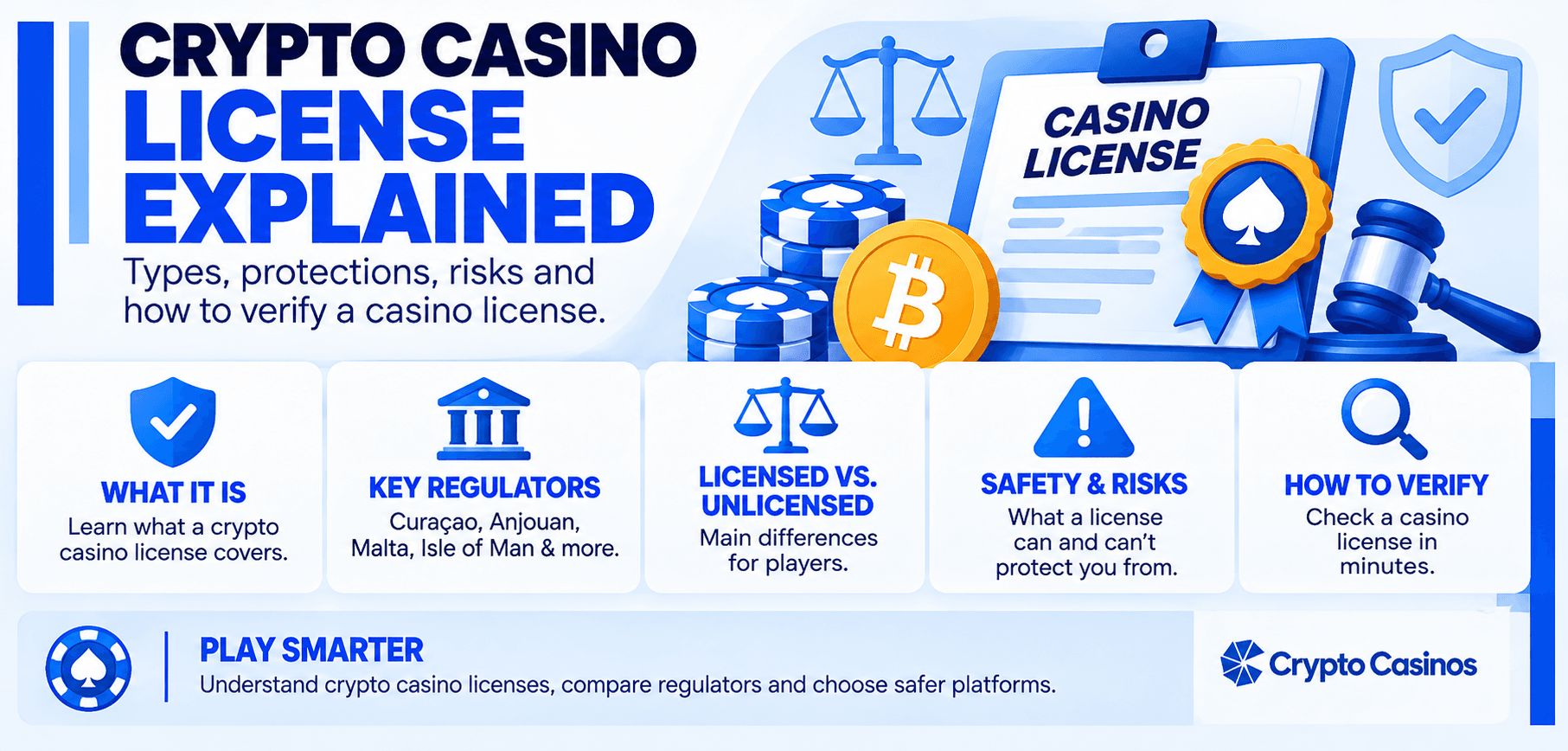
Crypto Casino License Explained

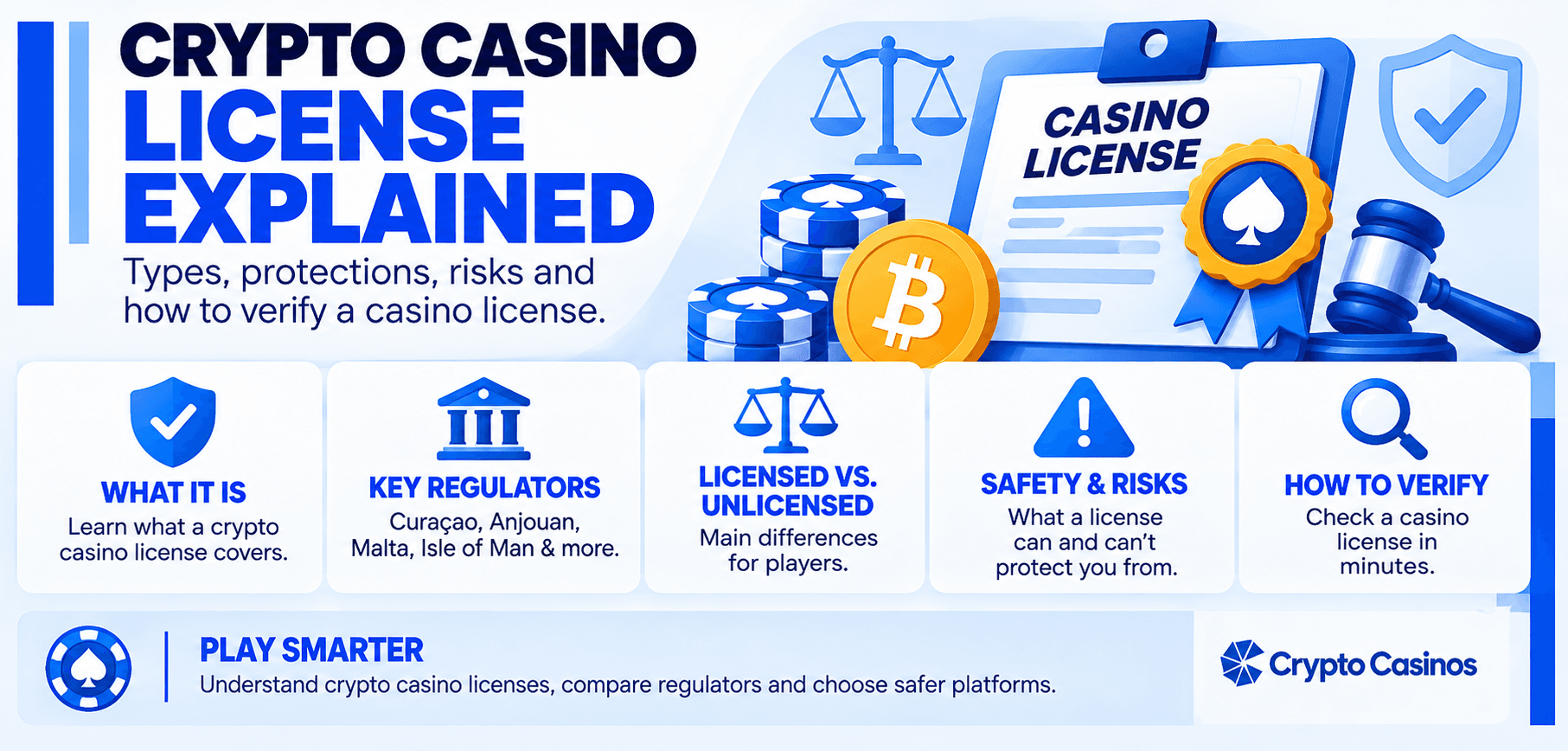
Does a crypto casino license guarantee a casino’s safety, and what happens if something goes wrong? Not all licenses offer the same player protections, and some crypto casinos operate without one. In this guide, you’ll learn about the different types of casino licenses, how they affect your gameplay, and how to verify one before depositing.
What is a Crypto Casino License?
A crypto casino license is an official gambling authorization that regulators issue to operators that accept crypto payments. These gambling authorizations are complete gambling licenses that cover all activities, including crypto payments. Crypto licenses generally establish rules and requirements for key casino operations, including:
- Game Fairness: Game standards for random number generators (RNGs), game integrity, testing and overall game mechanics.
- Player Complaints: Procedures and mechanisms for player complaints, disputes and resolving common issues.
- Regulatory Oversight: Monitoring operations, updating requirements, ensuring casinos stay compliant and enforcing penalties for violations.
- Financial Compliance: Anti-money laundering (AML) requirements, identity verification and privacy requirements.
- Player Protection: Transparent terms, rules, responsible gambling systems, account security and data protection.
The exact obligations and compliance requirements depend on the specific regulator. A licensed crypto casino doesn’t automatically guarantee your money is protected at all times or that all complaints will be resolved in your favor.
Licensed vs Unlicensed Crypto Casinos
The key difference between licensed and unlicensed crypto casinos is accountability. Licensed platforms must follow rules and comply with the standards set by the regulator. Unlicensed casinos have no external regulatory authority and can set their own standards for all processes.
Here are the main differences you, as a player, will experience depending on the casino’s licensing status.
| Casino Feature | Licensed Crypto Casino | Unlicensed Crypto Casino |
| Registration | The casino might require additional personal details and identity verification | Often allows quick registration with just a crypto wallet or email |
| KYC Requirements | KYC is usually mandatory and can be required before the first deposit, withdrawal or when reaching a specific threshold | Often have looser KYC triggers, and some are true no-KYC casinos |
| Crypto Withdrawals | Casinos must follow payment and player protection rules | Withdrawal processing policies and limits are set by the casino itself |
| Game Fairness | Games are usually subject to mandatory independent testing | May offer provably fair gambling and third-party audits but aren’t required to |
| Player Complaints | Usually are required to provide regulatory complaint channels and independent dispute resolution | Player complaints are usually limited to the casino’s support team |
| Responsible Gambling | Most provide essential responsible gambling tools like self-exclusion or deposit limits | Tools may be limited, voluntary or unavailable |
Does a Crypto Gambling License Make a Platform Safe?
A valid and trusted license is a good trust signal, but it doesn’t guarantee a casino is safe. Licensed casinos can still have payment delays, technical issues or financial issues. At the same time, malicious casinos can always look for loopholes to exploit players.
However, a licensed casino will have a harder time tricking or manipulating players. Still, regulators enforce rules and investigate complaints on different timelines, leaving room for theoretical abuse. Overall, a license is a good starting point but doesn’t mean you should trust a casino by default.

“When I’m reviewing a crypto casino, its licensing is the first thing I check, but it’s just the first step. A proven track record of payouts, transparent terms, fair games and responsible customer support play an equally important role in deciding whether I should recommend it.”
Common Crypto Casino Licenses Compared
There’s no single globally recognized crypto casino license. Below are the most reputable regulators for online crypto casinos. Here’s what they cover and what it means for you.
| Regulator Name | Crypto Casino Licensing | Player Protection | Things to Know |
| Curaçao Gaming Authority (CGA) | Issues online gambling licenses, including crypto casinos | Offers regulatory oversight, complaint procedures and compliance requirements for real protections | Curaçao gambling licenses are commonly issued to online crypto casinos |
| Anjouan Gaming | Issues licenses to operators offering casino games and crypto payments | Offers license verification and a reporting channel for license breaches, but disputes are sourced independently | Anjouan gaming licenses are more globally available and easier to obtain by casinos but don’t guarantee independent dispute resolution |
| Isle of Man Gambling Supervision Commission | Facilitates regulated online gambling with crypto arrangements | Oversees gambling operations, regulatory compliance and player funds | Has a more established regulatory framework but doesn’t have automatic crypto acceptance |
| Malta Gaming Authority (MGA) | Crypto gambling must meet financial and regulatory requirements | Robust player protection standards, formal complaint procedures and responsible gambling | A Malta gaming license offers strict regulatory oversight, but not many online casinos hold this license |
| UK Gambling Commission (UKGC) | Casinos must comply with strict AML, identity verification and gambling requirements | Extensive protection rules and independent dispute resolution | Only operators serving Great Britain must hold this license |
How to Verify a Crypto Casino’s License?
Sadly, malicious sites will try to fake their licensing status to appear “safe.” Luckily, you can verify a license’s legitimacy in just three steps. Here’s what you need to do:
Open the casino’s official website and scroll down to the footer of the homepage. In all of our crypto casino reviews, we found that they usually display their licensing statements there. It should include the licensing authority, operator, company name and license number.
Go to the regulator’s official website and look for a licensing registry or database. Don’t trust verification links on the casino's site, if there are any. Always go straight to the source.
All of the license information must match, including the license number and the company holding the license. Check the license issuance date and expiration date to confirm it’s still active. If available, go to the official licensed domain to confirm it’s the same site you’re looking for.

“I always tell players that a correct license number means nothing if it belongs to a different company or has expired. Always verify the domain and the operator. It just takes a few more minutes but can make a huge difference in finding a trustworthy platform.”
What Level of Protection Does a Crypto Casino License Provide?
The most valuable protection a valid license provides is less obvious, but it covers key casino services.

Game Fairness & Testing
Regulators usually require casinos to use trusted and tested gaming software with certified random number generators. Independent testing labs like eCOGRA can determine whether the games operate according to their mathematical specifications. Some casinos also offer provably fair games, letting players verify results themselves.

Player Funds & Withdrawals
Regulated crypto casinos must follow regulators' rules for handling payments and player balances. Some jurisdictions also require customer disclosure and fund protection. Still, each casino has its withdrawal limits, processing times, network fees and verification requirements that you should check.

KYC Requirements
Casino regulators usually require mandatory identity verification and anti-money laundering policies. However, they don’t require casinos to enforce KYC verification straight away. In fact, many casinos trigger KYC on an "as-needed" basis, such as after a specific withdrawal amount threshold, large payouts or suspicious account activity.

Responsible Gambling
In many cases, regulators require responsible gambling tools and resources. For example, many sites have self-exclusion and deposit limits that players can activate on their own or through support channels.
What if a Licensed Crypto Casino Won’t Pay?
Licensed casinos can provide a complaint route outside of support channels. However, the outcome depends on the circumstances and the regulator. If your withdrawal is rejected or delayed, here’s what you can do:
Go to the casino’s T&C page and check all withdrawal terms. Check any verification, withdrawal or wagering requirements. Make sure you haven’t breached any rules or made a mistake during withdrawal.
If you still haven’t determined why you’re having issues, contact customer support. Tell them about the issue and ask for an explanation. Always document your conversations.
Save all transaction hashes from your wallet, conversations with support, account details, any relevant betting history, relevant terms and capture screenshots. Document anything that’s relevant and can help your case.
Follow the casino's official complaint procedure. Be diligent and submit a complaint as quickly as possible. However, make sure you’ve provided as much information and evidence as possible.
If the issue still isn’t resolved and you feel you’ve been wronged, escalate the dispute. Contact the casino's regulator or the relevant third-party dispute resolution service.
Are Unlicensed Casinos Worth Comparing to Licensed Ones?
Some players prefer a casino without a license because it may offer greater privacy, simpler registration and fewer verification requirements. On the other hand, some new crypto casinos offer more decentralization and access to innovative crypto features.
For example, Betplay is a VPN-friendly and no-KYC casino. However, these advantages also carry additional risks. Without regulatory oversight and centralization, players have less recourse and fewer official channels for resolving disputes.
Unlicensed casinos can still be trustworthy, offer reputable software and have transparent terms. However, they aren’t accountable to any organization, so players must rely on themselves and be more independent. If you’re considering an unlicensed casino, carefully investigate its payment history, customer complaints and ownership information.
“I recommend going with a verified, licensed crypto casino that has a proven payout record. If you want to play at an unlicensed casino, be more cautious and informed, and check every aspect of the casino yourself. With no regulatory oversight, you are the only one responsible for protecting your interests if something goes wrong.”
Are Licensed Crypto Casinos Legal Worldwide?
Just because a crypto casino holds a valid license doesn’t mean it’s automatically legal in your area. First, some regulators explicitly prohibit players from specific countries and casinos under their licensing must comply with these regulations. On the other hand, countries have their own local gambling laws and require operators to hold specific (local) licenses.
In some jurisdictions, crypto casinos are fully banned, regardless of licensing. Casinos can also exclude certain countries in their terms and conditions, so always check the site to see if you can play. Also, check local laws before registering.
“No matter whether I'm looking at a licensed or unlicensed casino, I check my local laws and the list of banned countries on the site. These checks help me avoid restricted casinos and potential legal issues.”
FAQs
Do crypto casinos need a license to operate?
Which crypto casino license is best?
Can a licensed crypto casino be a scam?
How do I recognize a fake crypto casino license?

Vladimir is a senior iGaming writer and editor, adept at breaking down the key details of crypto casinos and sportsbooks so players don’t have to, delivering honest, player-focused information that actually matters.